
Frederick Douglass taught himself to read while enslaved, escaped at twenty, and spent fifty years using words as weapons — three autobiographies, a newspaper, and speeches presidents listened to. Few lives prove the power of language like his.
This collection of frederick douglass quotes draws on his 1845 Narrative, his speeches, and his later writings, keeping his original wording wherever a line is quoted. Douglass does not deal in soft comfort. He deals in courage, learning, and the refusal to stay quiet — which is why his lines still hit hard today. If these stir something in you, these life quotes for inspiration make a good next read.
Frederick Douglass Quotes on Freedom and Struggle
Douglass never pretended freedom was given politely. Progress, he argued, is demanded and defended — never simply received.
- “If there is no struggle, there is no progress.” — Frederick Douglass — From his 1857 West India Emancipation speech; the sentence his whole life proved true.
- “Power concedes nothing without a demand. It never did and it never will.” — Frederick Douglass — Also from 1857; a rule of politics he said applied to every age and country.
- “Find out just what any people will quietly submit to, and you have found out the exact measure of injustice and wrong which will be imposed upon them.” — Frederick Douglass — The other half of that speech — silence, he warned, sets the price of oppression.
- “It is not light that we need, but fire; it is not the gentle shower, but thunder. We need the storm, the whirlwind, and the earthquake.” — Frederick Douglass — From his 1852 Fourth of July speech, calling for urgency instead of polite applause.
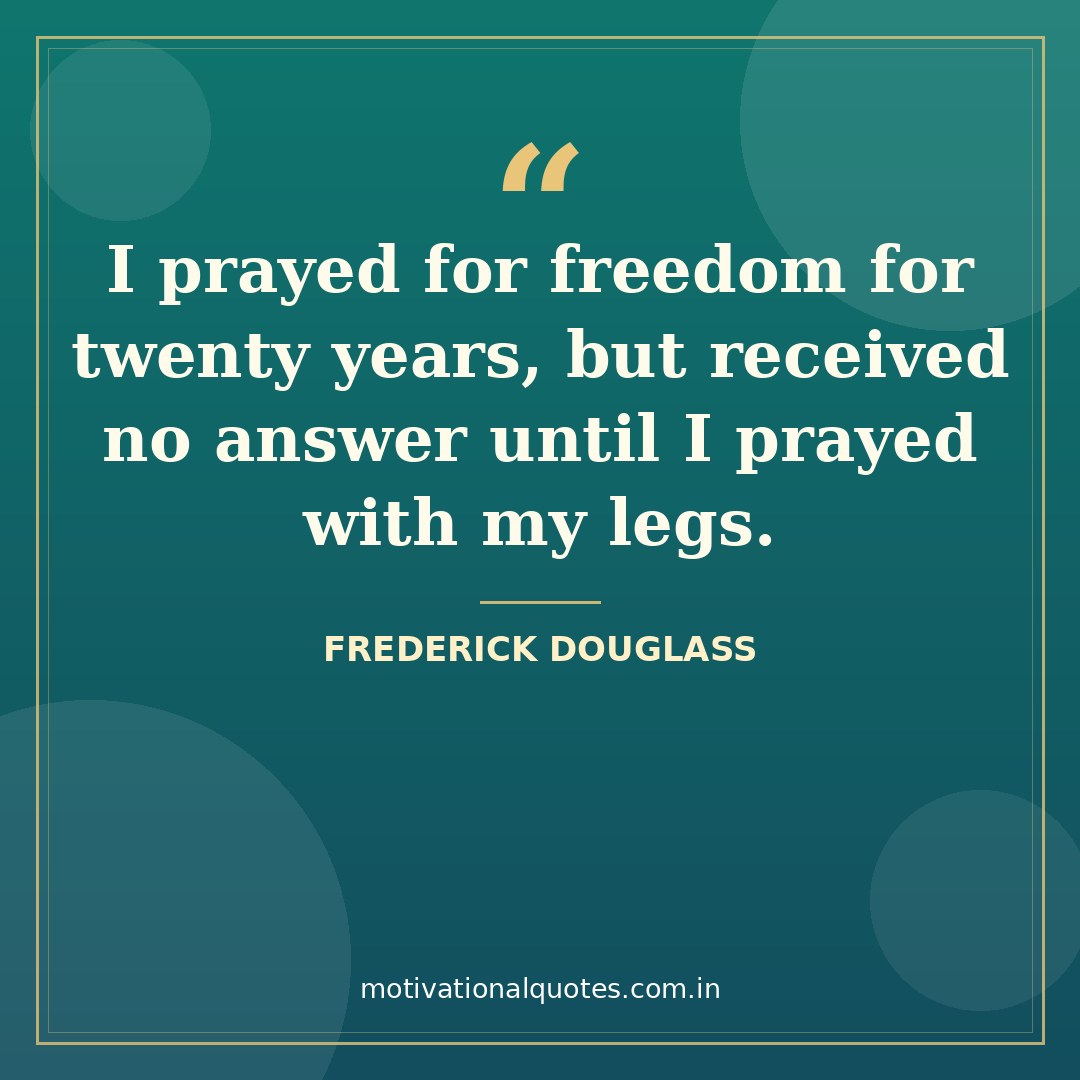
- “I prayed for freedom for twenty years, but received no answer until I prayed with my legs.” — Frederick Douglass — His dry summary of escape: prayer, for him, had to end in action.
- “The thing worse than rebellion is the thing that causes rebellion.” — Frederick Douglass — A line that redirects blame from the unrest to the injustice underneath it.
- “No man can put a chain about the ankle of his fellow man without at last finding the other end fastened about his own neck.” — Frederick Douglass — Oppression, he argued, imprisons the oppressor too.
- “Where justice is denied, where poverty is enforced, where ignorance prevails, and where any one class is made to feel that society is an organized conspiracy to oppress, rob and degrade them, neither persons nor property will be safe.” — Frederick Douglass — A warning about what a society earns by refusing fairness.
Frederick Douglass Quotes on Education and Reading
For Douglass, literacy was the doorway out of slavery — being warned that reading would “unfit” him for bondage told him exactly where the power lay.
- “Once you learn to read, you will be forever free.” — Frederick Douglass — The lesson he drew from being forbidden books as a boy.
- “Knowledge makes a man unfit to be a slave.” — Frederick Douglass — What he understood the moment his master stopped his reading lessons in Baltimore.
- “Education means emancipation. It means light and liberty. It means the uplifting of the soul of man into the glorious light of truth.” — Frederick Douglass — From an 1894 school address, late in life, still preaching the same gospel of learning.
- “A little learning, indeed, may be a dangerous thing, but the want of learning is a calamity to any people.” — Frederick Douglass — His answer to anyone who called education risky for the poor.
- “The silver trump of freedom had roused my soul to eternal wakefulness.” — Frederick Douglass — From the Narrative — antislavery reading ended his contentment with bondage.
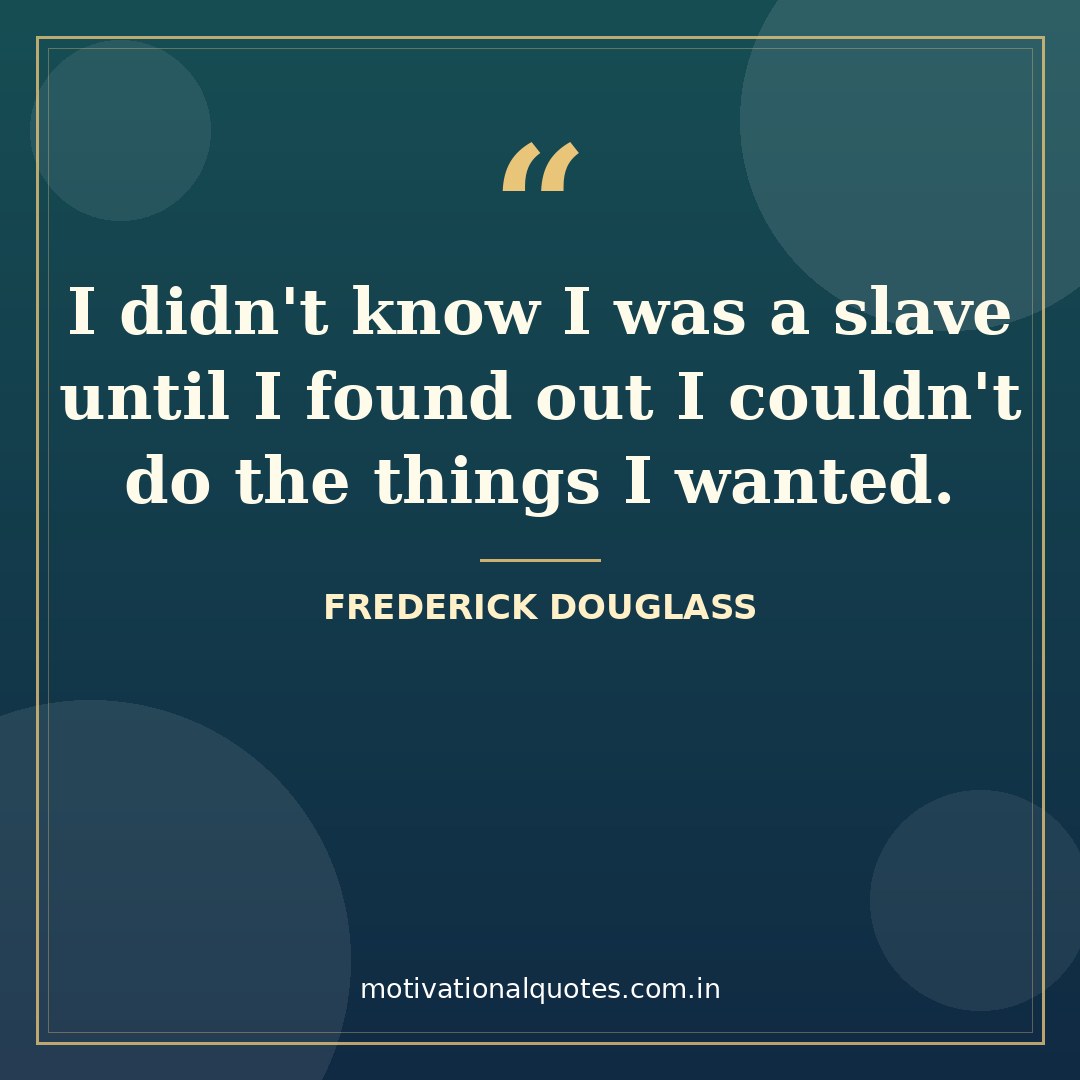
- “I didn’t know I was a slave until I found out I couldn’t do the things I wanted.” — Frederick Douglass — A childhood realisation, plainly told — freedom is first noticed in its absence.
- “People might not get all they work for in this world, but they must certainly work for all they get.” — Frederick Douglass — His practical philosophy for students: effort is not optional, whatever the odds.
Frederick Douglass Quotes from the Narrative
His 1845 Narrative was written partly to prove a Black man could write such a book at all. Its scenes still carry the force of witness.
- “You have seen how a man was made a slave; you shall see how a slave was made a man.” — Frederick Douglass — The turning point of the Narrative — his fight with the slave-breaker Covey.
- “I have observed this in my experience of slavery — that whenever my condition was improved, instead of its increasing my contentment, it only increased my desire to be free.” — Frederick Douglass — Comfort does not quiet a person who has tasted dignity.
- “Between the Christianity of this land and the Christianity of Christ, I recognize the widest possible difference.” — Frederick Douglass — From the Narrative’s appendix, separating real faith from the religion used to defend slavery.
- “I love that pure, peaceable, and impartial Christianity of Christ; I therefore hate the corrupt, slaveholding, women-whipping, cradle-plundering, partial and hypocritical Christianity of this land.” — Frederick Douglass — The same appendix, in full voice — he attacked hypocrisy, never faith itself.
- “The soul that is within me no man can degrade.” — Frederick Douglass — A sentence of pure self-possession from his early lecturing years.
- “I prefer to be true to myself, even at the hazard of incurring the ridicule of others, rather than to be false, and to incur my own abhorrence.” — Frederick Douglass — From the Narrative; integrity, for him, outranked approval every time.
Frederick Douglass Quotes on America and Justice
Douglass loved his country’s founding promises enough to hold it to them. His most famous speech asked what Independence Day meant to the enslaved.
- “What, to the American slave, is your 4th of July?” — Frederick Douglass — The question at the heart of his 1852 Rochester speech, still quoted every July.
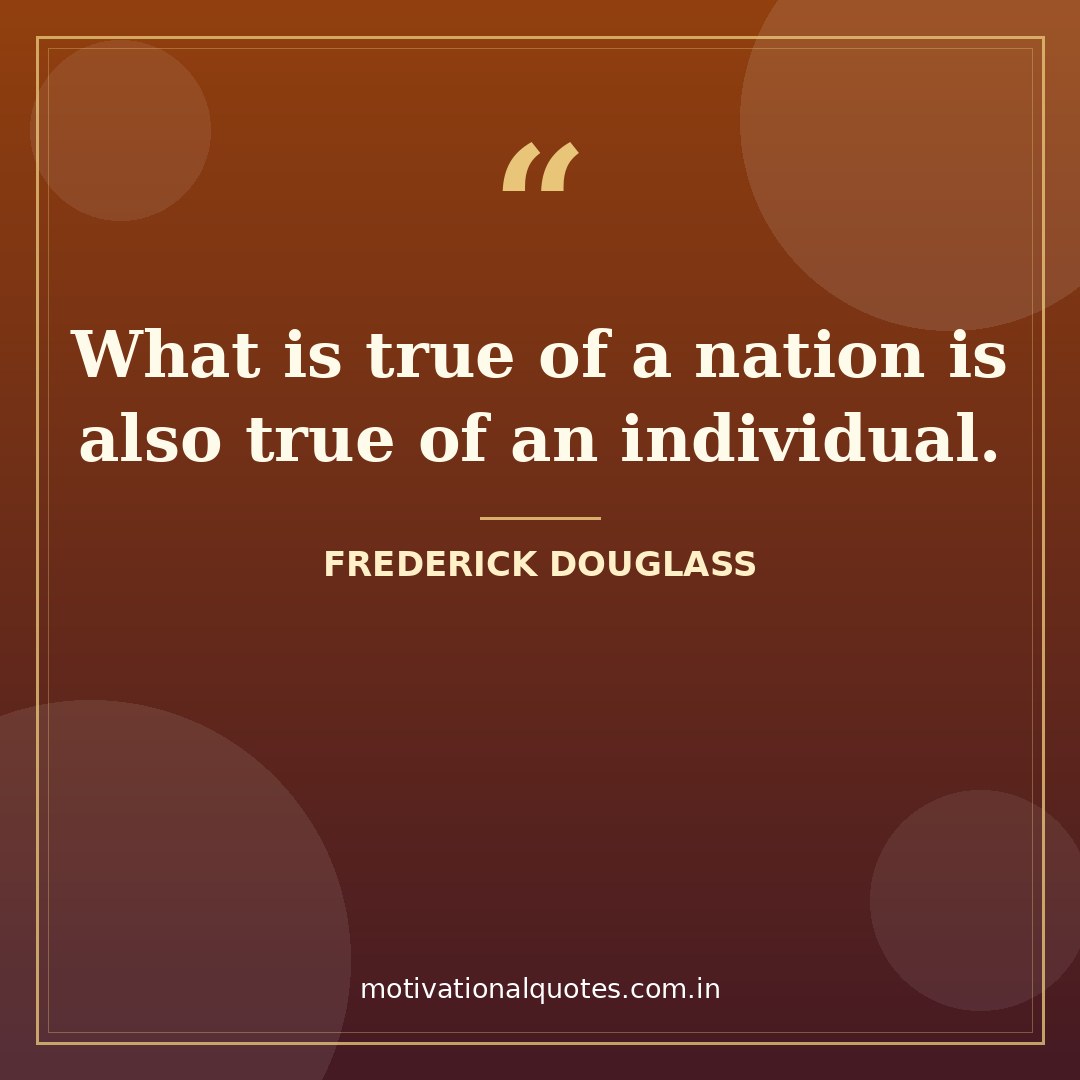
- “What is true of a nation is also true of an individual.” — Frederick Douglass — A simple test he applied to countries and people alike.
- “The life of the nation is secure only while the nation is honest, truthful, and virtuous.” — Frederick Douglass — From a late speech on the lessons of the Civil War era.
- “A battle lost or won is easily described, understood, and appreciated, but the moral growth of a great nation requires reflection, as well as observation, to appreciate it.” — Frederick Douglass — Progress, he reminded listeners, is slower than war.
- “We have to do with the past only as we can make it useful to the present and the future.” — Frederick Douglass — History, in his hands, was a tool — never a resting place.
- “The white man’s happiness cannot be purchased by the black man’s misery.” — Frederick Douglass — A moral equation he returned to throughout the Reconstruction years.
Frederick Douglass Quotes on Character and Speaking Up
Beyond slavery and politics, Douglass wrote about dignity, work, and the duty to use your voice — themes that fit any life. For a daily dose of this resolve, try a thought of the day each morning.
- “I would unite with anybody to do right and with nobody to do wrong.” — Frederick Douglass — His rule for alliances, stated in a speech on women’s suffrage in 1888.
- “Right is of no sex, truth is of no color, God is the Father of us all, and we are all brethren.” — Frederick Douglass — The motto printed on his newspaper, The North Star.
- “A gentleman will not insult me, and no man not a gentleman can insult me.” — Frederick Douglass — Dignity as armour: an insult, he reasoned, can only land if it comes from someone respectable.
- “To suppress free speech is a double wrong. It violates the rights of the hearer as well as those of the speaker.” — Frederick Douglass — From his 1860 Boston speech defending free expression after a mob broke up a meeting.
- “Man’s greatness consists in his ability to do and the proper application of his powers to things needed to be done.” — Frederick Douglass — From his “Self-Made Men” lecture, which he refined and delivered for decades.
- “A man is worked upon by what he works on. He may carve out his circumstances, but his circumstances will carve him out as well.” — Frederick Douglass — Also from “Self-Made Men” — your work shapes you as surely as you shape it.
- “One and God make a majority.” — Frederick Douglass — attributed to Douglass — His reported answer when told his cause had too few supporters.
- “It is easier to build strong children than to repair broken men.” — Frederick Douglass — attributed to Douglass — Widely shared in his name; the sentiment matches his lifelong faith in educating the young.
How to Use These Quotes
Douglass belongs in classrooms, speeches, and serious moments. Teachers use the education quotes to open lessons on literacy; speakers borrow “no struggle, no progress” when a room needs spine rather than comfort. His Fourth of July line anchors talks about holding a country to its promises.
For personal use, copy one line into a journal before hard work — his words steady you before an exam or a difficult conversation. On social media, the short lines work best as short quotes with his name attached; he earned that credit the hard way.
What Douglass Teaches About Your Own Voice
Douglass was not born a great speaker. He practised from a schoolbook of speeches, The Columbian Orator, bought with saved pennies, and rehearsed alone. The polish people later called genius was built sentence by sentence.
That is the quiet lesson under the famous lines: your voice is not a gift you wait for, it is a skill you train. Read widely, write honestly, and say the true thing in rooms where it is unwelcome. His biography makes the point best — read more on his Wikipedia page.
Frequently Asked Questions
What is Frederick Douglass’s most famous quote?
“If there is no struggle, there is no progress,” from his 1857 emancipation speech in Canandaigua, New York, is quoted most often. “Power concedes nothing without a demand,” from the same speech, runs second.
What did Frederick Douglass say about education?
He called learning the pathway from slavery to freedom. Forbidden to read as a child, he taught himself in secret — and later said that once you learn to read, you will be forever free.
What is Douglass’s Fourth of July speech about?
Delivered in Rochester in 1852, it praised America’s founders while asking how a nation could celebrate liberty while holding millions in slavery. It is considered one of the greatest American speeches.
Did Frederick Douglass write his own autobiography?
Yes — three. The Narrative (1845), My Bondage and My Freedom (1855), and Life and Times of Frederick Douglass (1881, revised 1892). The Narrative was a bestseller that helped convince readers slavery had to end.
Why are Douglass’s quotes still used today?
Because he wrote about permanent things — freedom, education, courage, hypocrisy — in sentences built to be remembered. Movements for justice still quote him because his arguments were never answered, only inherited.
Conclusion
Douglass started life as someone the law called property and ended it as one of his country’s conscience-keepers — and the bridge between those lives was built of words. Save the lines that make you sit up straighter. Then, in his spirit, do the harder thing they point to: learn something, say something, demand something just.
