
George Orwell Quotes: 40 Powerful Words on Truth and Power
George Orwell, born Eric Arthur Blair in 1903, wrote fiction and essays that still shape how we talk about politics, language, and truth. His novels Animal Farm, published in 1945, and Nineteen Eighty-Four, published in 1949, gave the world words like Big Brother, doublethink, and thought police.
This collection gathers George Orwell quotes from his novels, essays such as Politics and the English Language and Why I Write, and his journalism. The themes are serious: power, freedom, war, honesty, and the way words can clarify or corrupt thought.
Read them slowly, and notice how many were written as warnings. Learn more on his Wikipedia page.
George Orwell Quotes on Truth and Reality
- “In a time of deceit telling the truth is a revolutionary act.” — George Orwell, attributed to Orwell, and a summary of his life’s work in one line.
- “What is history but a fable agreed upon?” — George Orwell, attributed in Orwell discussions of how victors shape records, echoing an older saying.
- “Freedom is the freedom to say that two plus two make four. If that is granted, all else follows.” — George Orwell, from Nineteen Eighty-Four, spoken through Winston Smith’s diary.
- “For a creative writer possession of the truth is less important than emotional sincerity.” — George Orwell, from his essay writing on honesty in craft.
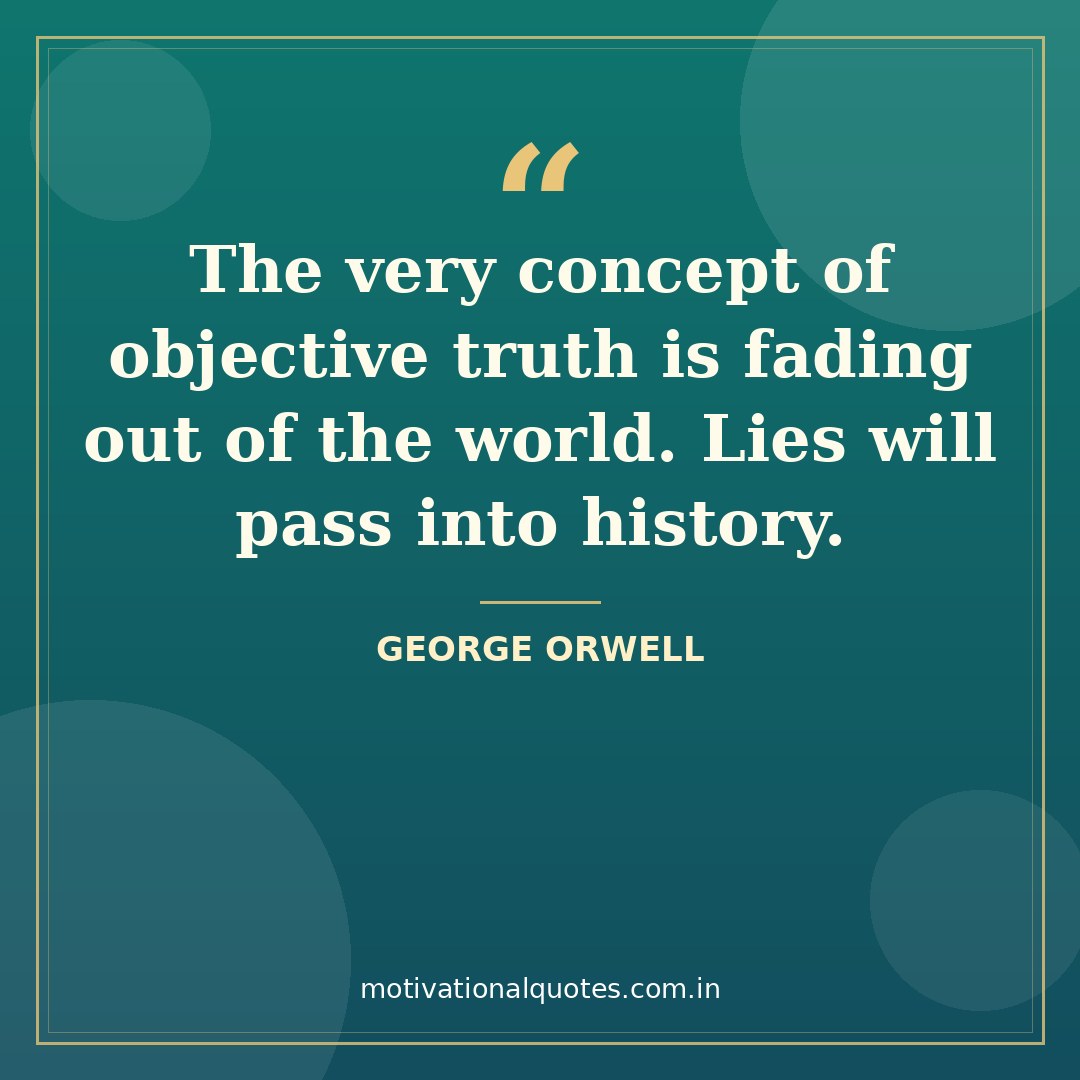
- “The very concept of objective truth is fading out of the world. Lies will pass into history.” — George Orwell, from Looking Back on the Spanish War, a fear that feels current.
- “If you want a picture of the future, imagine a boot stamping on a human face — forever.” — George Orwell, from Nineteen Eighty-Four, the bleakest image in the novel.
- “In the end the Party would announce that two and two made five, and you would have to believe it.” — George Orwell, from Nineteen Eighty-Four, showing how power bends arithmetic and minds.
- “Who controls the past controls the future. Who controls the present controls the past.” — George Orwell, the Party slogan in Nineteen Eighty-Four, and a lesson in propaganda.
For daily reflection on serious ideas, pair these with a thought of the day.
George Orwell Quotes on Power and Politics
- “Power is not a means; it is an end. One does not establish a dictatorship in order to safeguard a revolution; one makes the revolution in order to establish the dictatorship.” — George Orwell, from Nineteen Eighty-Four, spoken by O’Brien.
- “All animals are equal, but some animals are more equal than others.” — George Orwell, the famous final commandment in Animal Farm.
- “Political language is designed to make lies sound truthful and murder respectable, and to give an appearance of solidity to pure wind.” — George Orwell, from Politics and the English Language.
- “The essence of being human is that one does not seek perfection.” — George Orwell, from his essay on Gandhi, Reflections on Gandhi.
- “If liberty means anything at all, it means the right to tell people what they do not want to hear.” — George Orwell, from his proposed preface to Animal Farm.
- “Every generation imagines itself to be more intelligent than the one that went before it, and wiser than the one that comes after it.” — George Orwell, attributed to Orwell, and a humbling note on pride.
- “Power is in tearing human minds to pieces and putting them together again in new shapes of your own choosing.” — George Orwell, from Nineteen Eighty-Four, a chilling definition of total control.
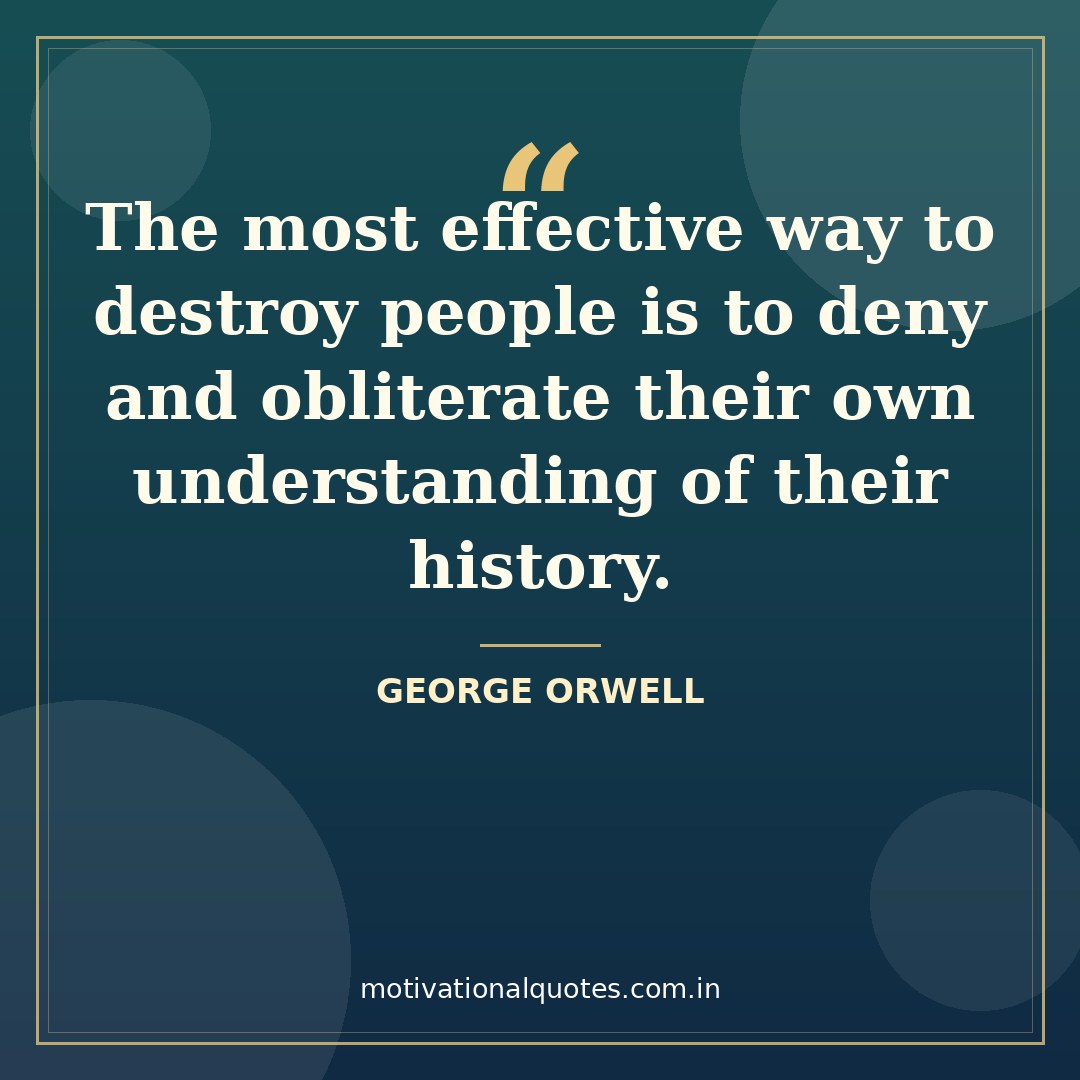
- “The most effective way to destroy people is to deny and obliterate their own understanding of their history.” — George Orwell, attributed to Orwell, reflecting his writing on memory and propaganda.
George Orwell Quotes on Language and Writing
- “Never use a long word where a short one will do.” — George Orwell, one of his six famous rules in Politics and the English Language.
- “If it is possible to cut a word out, always cut it out.” — George Orwell, another of his writing rules, and advice every editor repeats.
- “Never use a foreign phrase, a scientific word, or a jargon word if you can think of an everyday English equivalent.” — George Orwell, from the same essay, defending plain language.
- “But if thought corrupts language, language can also corrupt thought.” — George Orwell, from Politics and the English Language, his two-way warning.
- “Good prose should be transparent, like a window pane.” — George Orwell, from Why I Write, his standard for clear writing.
- “I write it because there is some lie that I want to expose, some fact to which I want to draw attention.” — George Orwell, from Why I Write, explaining his political purpose.
- “When I sit down to write a book, I do not say to myself, I am going to produce a work of art. I write it because there is some lie that I want to expose.” — George Orwell, from Why I Write, in fuller form.
- “Writing a book is a horrible, exhausting struggle, like a long bout with some painful illness.” — George Orwell, from Why I Write, honest words every author recognizes.
Writers who love clear language will also value broader life quotes for inspiration with a reflective tone.
George Orwell Quotes on Freedom and Society
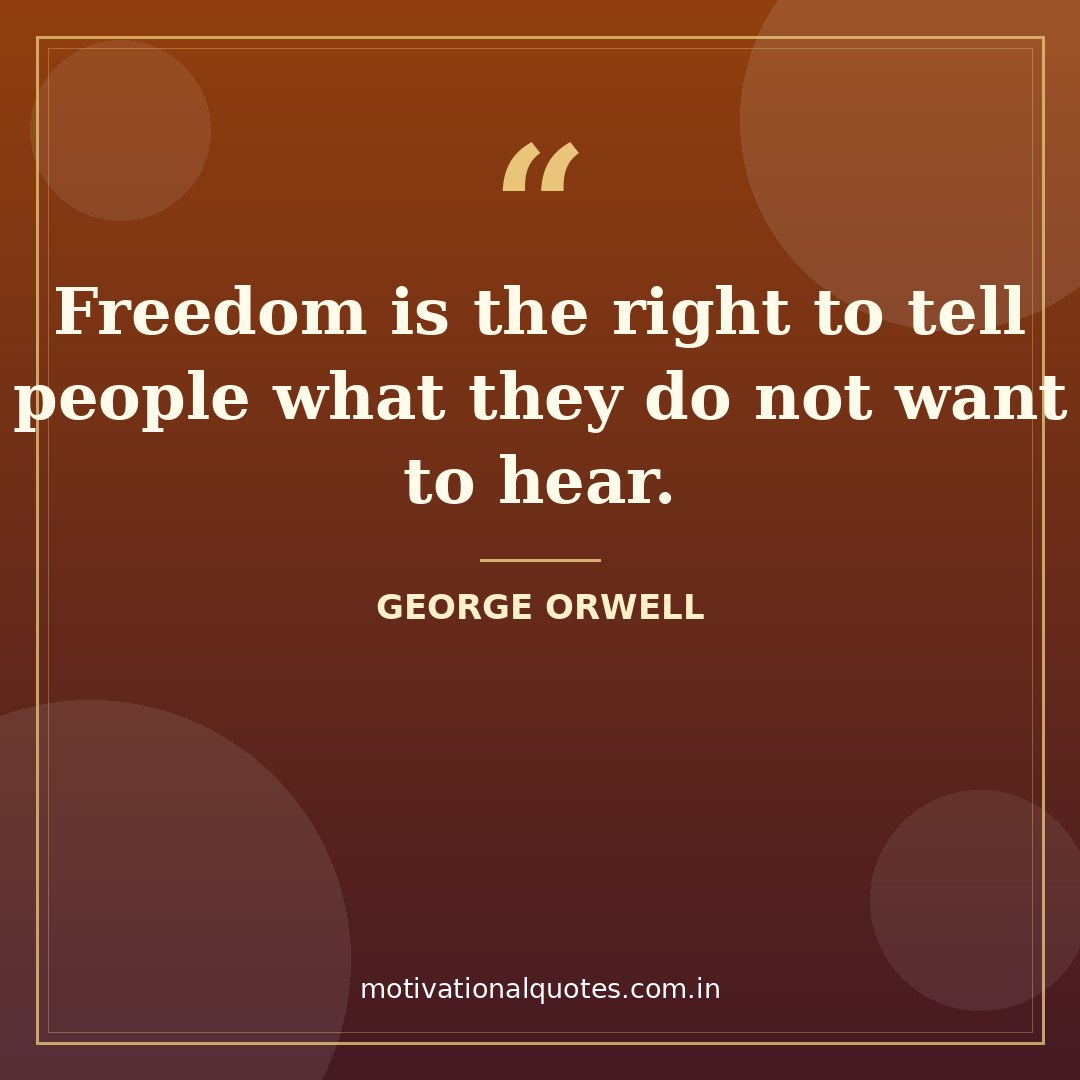
- “Freedom is the right to tell people what they do not want to hear.” — George Orwell, a short form of his Animal Farm preface line, often quoted on press freedom.
- “If you want to keep a secret, you must also hide it from yourself.” — George Orwell, from Nineteen Eighty-Four, on life under constant surveillance.
- “Big Brother is watching you.” — George Orwell, the Party slogan in Nineteen Eighty-Four, now a global shorthand for surveillance.
- “Doublethink means the power of holding two contradictory beliefs in one’s mind simultaneously, and accepting both of them.” — George Orwell, his definition from Nineteen Eighty-Four.
- “War is peace. Freedom is slavery. Ignorance is strength.” — George Orwell, the three slogans of the Party in Nineteen Eighty-Four.
- “Until they become conscious they will never rebel, and until after they have rebelled they cannot become conscious.” — George Orwell, from Nineteen Eighty-Four, on the trap facing the proles.
- “The choice for mankind lies between freedom and happiness and for the great bulk of mankind, happiness is better.” — George Orwell, attributed discussion from Nineteen Eighty-Four’s themes on security over liberty.
- “Men can only be happy when they do not assume that the object of life is happiness.” — George Orwell, attributed to Orwell, and a paradox worth pondering.
George Orwell Quotes on Life and Human Nature
- “Perhaps one did not want to be loved so much as to be understood.” — George Orwell, from Nineteen Eighty-Four, a tender line inside a bleak novel.
- “The best books are those that tell you what you know already.” — George Orwell, attributed to Orwell, and a comforting thought for rereaders.
- “At age fifty, every man has the face he deserves.” — George Orwell, noted in his final notebook, a wry line on aging and character.
- “Happiness can exist only in acceptance.” — George Orwell, attributed to Orwell, and a quiet counterpoint to his political writing.
- “All the war-propaganda, all the screaming and lies and hatred, comes invariably from people who are not fighting.” — George Orwell, from Homage to Catalonia era writing on war at home.
- “To see what is in front of one’s nose needs a constant struggle.” — George Orwell, from In Front of Your Nose, an essay on obvious truths we avoid.
- “Man is the only creature that consumes without producing.” — George Orwell, from Animal Farm, spoken in Old Major’s speech about humans and animals.
- “Four legs good, two legs bad.” — George Orwell, the sheep’s slogan in Animal Farm, simple words with a satirical bite.
Short, memorable lines like these belong in any set of short quotes with real weight.
How to Use These Quotes
Use Orwell quotes in essays on media, censorship, technology, and government. His language gives you precise terms, like doublethink, that make an argument clearer.
In a classroom, pair a quote with a current headline and ask students to discuss where Orwell’s warning fits and where it does not. That balance keeps the lesson honest.
For book clubs reading Nineteen Eighty-Four or Animal Farm, choose one quote per chapter as a discussion starter. The power and language sections work especially well.
On social media, use the writing rules and the two plus two line. They are widely understood and invite thoughtful replies rather than arguments.
How to Choose the Right Quote
For an essay on truth, start with the two plus two quote. It is concrete, famous, and easy to explain.
For a talk on language, use the political language quote or the window pane quote. Both show why Orwell cared so much about plain words.
For a personal journal, the understood-not-loved line and the face at fifty line are the most human. They reveal the reflective Orwell behind the political warnings.
Frequently Asked Questions
What is George Orwell’s most famous quote?
“Big Brother is watching you” and “All animals are equal, but some animals are more equal than others” are his most famous lines.
What books do most Orwell quotes come from?
Nineteen Eighty-Four, Animal Farm, and essays including Politics and the English Language, Why I Write, and Homage to Catalonia-based writing.
Did Orwell invent words we still use?
Yes. Big Brother, doublethink, thought police, newspeak, and the adjective Orwellian all come from his work and its influence.
Are Orwell quotes only political?
No. His writing rules, observations on happiness, and lines about being understood show a reflective, personal side.
What does Orwellian mean?
It describes conditions resembling the totalitarian world of Nineteen Eighty-Four, especially surveillance, propaganda, and manipulated language.
Conclusion
Orwell wrote to expose lies and defend clear thought, and his sentences still do that work today. That is why a quote from 1949 can describe a debate this week.
Keep the quotes that make you pause. Use them to write more plainly, read more carefully, and ask better questions about the words aimed at you every day.
